Which Direction Does a 12x27x4 Filter Go In?
At FilterBuy, we've manufactured millions of filters and heard this question more than almost any other — and it makes sense. There's no universal standard for labeling, slots vary by system, and a backwards filter doesn't immediately set off alarms. It just quietly works against you. Here's the short answer: the airflow arrow on your 12x27x4 filter frame points toward the blower motor — away from the return duct, into the system. That's it. But getting it right matters more than most homeowners realize. A reversed filter restricts airflow, strains your equipment, and sends unfiltered air straight through your system. This page covers how to find the arrow, how to orient the filter correctly in your specific setup, and what to watch for if you suspect a previous install was backwards.
Quick Answers
Which Direction Does a 12x27x4 Filter Go In?
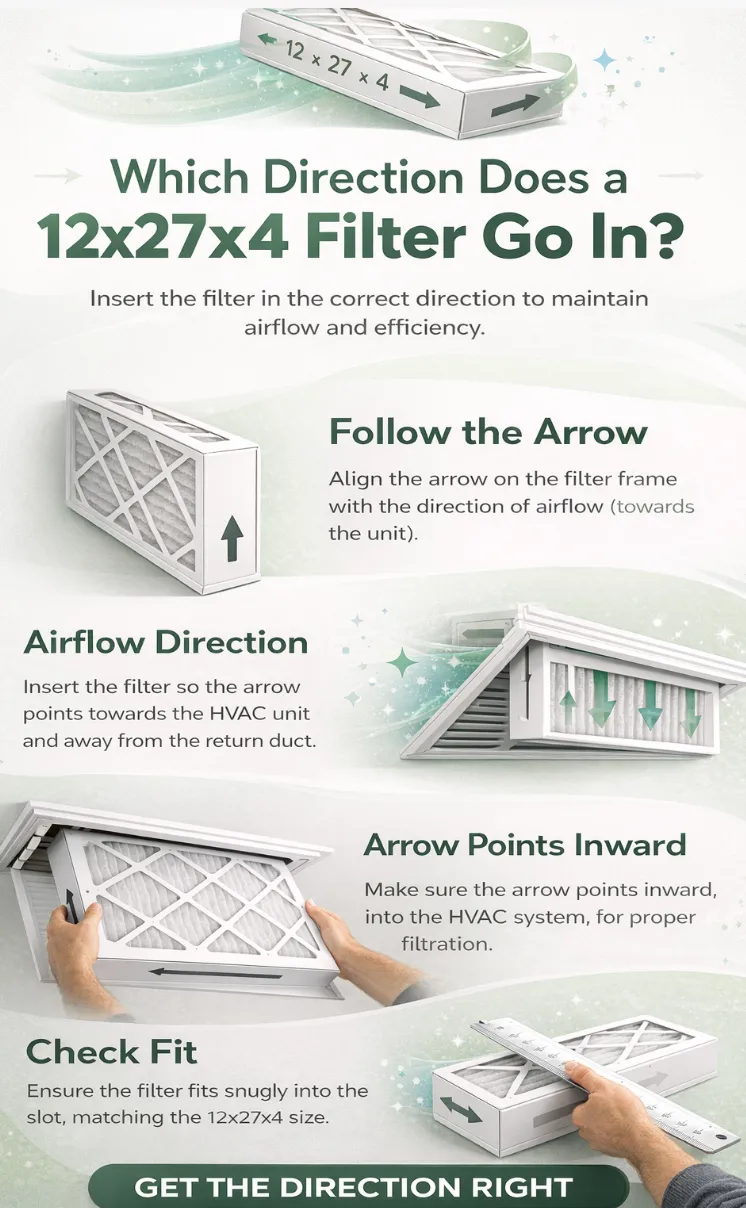
The airflow arrow on your 12x27x4 filter frame points toward the blower motor — away from the return duct and into the system. After manufacturing millions of filters, we know this single detail is the most important part of any filter install.
Arrow points toward the blower motor.
Arrow faces away from the return air duct.
Wire mesh or support grid side always faces toward the blower.
If the arrow is faded or missing, use the mesh side as your guide.
A reversed filter strains your system, raises energy bills, and bypasses filtration entirely.
Get the direction right, and your 12x27x4 filter does exactly what it was engineered to do.
Top Takeaways: Which Direction Does a 12x27x4 Filter Go In?
Follow the arrow — every time.
The airflow arrow points toward the blower motor.
It faces away from the return duct and into the system.
That arrow is the only installation guide you need.
A reversed filter fails silently.
No warning lights. No obvious symptoms.
It strains your blower, bypasses filtration media, and inflates energy bills.
Damage compounds quietly over months.
Three things make a correct install.
Arrow pointing toward the blower motor.
Frame seated flush with no gaps around any edge.
Filter slides in cleanly with no force required.
Replacement schedule matters as much as direction.
A correctly installed but overdue filter offers little protection.
Match your replacement frequency to your household's specific needs.
When in doubt, replace sooner rather than later.
FilterBuy manufactures your exact filter.
Available in MERV 8, MERV 11, and MERV 13.
Built to the exact dimensions of 12x27x4 air filters.
Backed by over a decade of American manufacturing experience.
Why Filter Direction Matters in Your HVAC System
Your 12x27x4 filter does more than catch dust — it protects your blower motor, heat exchanger, and coil from debris that shortens equipment life. But it only works when air moves through it in the right direction. Filters are built with a structured media layer designed to capture particles as air passes from one specific side to the other. Flip it around, and that structure works against airflow instead of with it.
How to Find the Airflow Arrow on a 12x27x4 Filter
Look at the cardboard frame along any edge of your filter. You'll find a printed arrow — sometimes accompanied by the words "Airflow" or "This Side Toward Furnace." That arrow tells you exactly which way the filter needs to face when installed. If the arrow is faded or missing, the wire mesh or support grid side of the filter always faces away from the return duct, toward the blower.
Which Direction Does the Arrow Point?
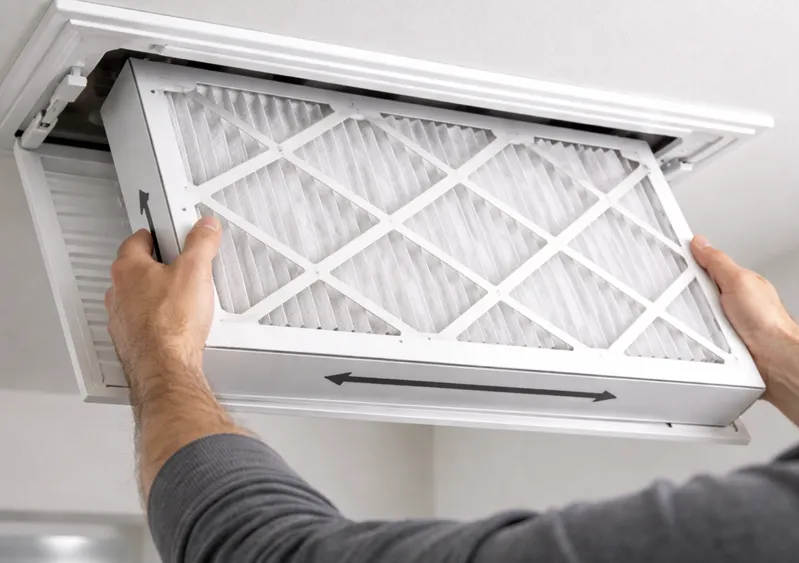
The arrow points toward the blower motor — into your HVAC system, away from the return air duct. When you slide your 12x27x4 filter into the slot, the arrow should point inward, in the direction air is traveling through the system. A simple way to remember it: air pulls in through the return, passes through the filter, and moves toward the blower. Your arrow follows that same path.
Horizontal vs. Vertical Filter Slots — Does Direction Change?
Installation orientation depends on your system's filter housing. In a horizontal slot, the arrow points in the direction of airflow — typically toward the air handler. In a vertical slot, the arrow points upward or downward depending on which direction your system draws air. When in doubt, locate your return duct and point the arrow away from it. The physics don't change regardless of how your slot is positioned.
What Happens If You Install a 12x27x4 Filter Backwards?
A backwards filter creates resistance your system wasn't designed to handle. Your blower works harder to pull air through the wrong side of the media, energy consumption climbs, and your equipment wears faster. Worse, a reversed filter can collapse under the pressure differential — sending filter material directly into your blower. Even a short period of backwards installation adds unnecessary stress to a system built for consistent, unrestricted airflow in one direction.
How to Double-Check Your Install Before Closing the Housing
Before sliding the access panel back into place, take five seconds to confirm three things. First, the arrow on the filter frame is visible and pointing into the system. Second, the filter fits snugly with no gaps around the edges — gaps allow unfiltered air to bypass the media entirely. Third, the frame sits flush and flat with no bowing or bending. A properly installed 12x27x4 filter should slide in cleanly, seal evenly, and require no force to seat correctly.
"After manufacturing millions of filters and fielding countless installation questions, the one thing we know for certain is that a backwards filter never announces itself — it just quietly costs you money, strains your equipment, and shortens the life of a system that deserved better."
7 Resources That Answer Every Question About 12x27x4 Filter Direction and Installation
At FilterBuy, we're obsessed with making sure every homeowner has the information they need to protect their family, their home, and their HVAC system. After over a decade of manufacturing experience and millions of customer interactions, we know that correct filter installation starts with understanding the "why" behind it. These seven resources give you the full picture.
U.S. Department of Energy: How Filter Installation Affects Your Energy Bills
Most homeowners don't realize a backwards filter shows up on their energy bill before it shows up anywhere else. The DOE's Energy Saver guide connects proper filter orientation directly to HVAC efficiency and monthly energy costs — and the numbers may surprise you. energy.gov/energysaver/maintaining-your-air-conditioner
EPA: What Improper Filter Installation Does to Your Indoor Air Quality
We've seen firsthand how a reversed filter compromises more than just equipment — it puts the air your family breathes at risk. The EPA's residential air filtration guide explains exactly how filters function within your system and why correct installation is the first line of defense for healthier indoor air. epa.gov/indoor-air-quality-iaq/air-cleaners-and-air-filters-home
ASHRAE: The Engineering Science Behind Airflow Direction in Filter Media
When we design and manufacture filters, ASHRAE standards are the foundation we build on. Their filtration technical resources explain why filter media is engineered for one-directional airflow — and what happens structurally when that direction is reversed. This is the same reference HVAC engineers rely on in the field. ashrae.org/technical-resources/filtration-and-air-cleaning
Energy Star: A Practical HVAC Maintenance Checklist Built Around Correct Filter Use
Protecting your family's comfort shouldn't be complicated. Energy Star's homeowner maintenance guide breaks filter installation and seasonal HVAC upkeep into clear, actionable steps — making it one of the most useful checklists available for keeping your system running the way it should. energystar.gov/campaign/heating_cooling/hvac_maintenance
NADCA: How a Backwards Filter Leads to Duct Contamination Over Time
One of the things we've learned from working with millions of customers is that a single bad filter install can quietly create problems that compound over time. NADCA's homeowner resources explain how improper installation allows unfiltered debris to accumulate inside ductwork — and what that means for your air quality and system performance down the road. nadca.com/homeowners/resources
ACCA: Professional Installation Standards Your HVAC Technician Follows
We believe an informed homeowner is an empowered one. The Air Conditioning Contractors of America publishes the same installation and maintenance standards certified HVAC professionals follow in the field — including filter orientation protocols — so you can verify your own install meets industry expectations with confidence. acca.org/consumer-resources
FilterBuy: Your Complete Guide to Filter Sizing, MERV Ratings, and Airflow Direction
This is where our decade-plus of manufacturing experience meets plain-language guidance built for real homeowners. FilterBuy's resource hub covers 12x27x4-specific sizing, MERV performance levels, and correct installation direction — because protecting your greatest assets starts with getting the basics exactly right. filterbuy.com/resources
Supporting Statistics on 12x27x4 Filter Direction and HVAC System Performance
After a decade of manufacturing and millions of customer interactions, we've seen incorrect filter installation drive up energy bills, accelerate equipment failures, and quietly degrade indoor air quality. The research confirms what we've witnessed firsthand.
The Energy Cost of Getting Filter Direction Wrong
Source: U.S. Department of Energy — Energy Saver energy.gov/energysaver/maintaining-your-air-conditioner
A clogged or incorrectly installed filter drives energy consumption up 5% to 15%.
Customers who've run a backwards filter for months report higher bills and harder-working systems.
Correct installation is one of the simplest, highest-return maintenance steps available.
Why Filter Installation Is One of the Most Impactful Decisions You Make as a Homeowner
Source: U.S. Energy Information Administration — Residential Energy Consumption Survey eia.gov/energyexplained/use-of-energy/homes.php
Heating and cooling account for nearly 51% of all energy use in a typical American home.
Your HVAC system is the hardest-working and most expensive system under your roof.
Correct filter orientation directly impacts how efficiently — and how long — that system performs.
What a Reversed Filter Means for the Air Your Family Breathes
Source: U.S. Environmental Protection Agency — Indoor Air Quality epa.gov/report-environment/indoor-air-quality
The EPA ranks indoor air pollution among the top five environmental health risks in the U.S.
Indoor air tests two to five times more polluted than outdoor air in many homes.
A reversed filter allows unfiltered air to bypass the media and circulate through your living spaces.
Getting filter direction right protects both your equipment and the people inside your home.
Final Thoughts on Which Direction Does a 12x27x4 Filter Go In?
After manufacturing millions of filters and working directly with homeowners across the country, our perspective goes beyond "follow the arrow." Understanding why direction matters is what separates a homeowner who maintains their system from one who unknowingly shortens its life. Here's our honest opinion: filter direction looks trivially simple but carries consequences that compound quietly over time. A reversed 12x27x4 filter doesn't trigger a warning light. It just works against you.
A backwards filter silently causes:
Increased strain on your blower motor
Unfiltered air bypassing the media entirely
Rising energy bills with no obvious explanation
Degraded indoor air quality while everything appears normal
What a decade of manufacturing experience has taught us:
The homeowners who protect their systems best aren't those with the most expensive equipment. They're the ones who get the fundamentals right, every single time. Filter direction is one of those fundamentals. Getting your 12x27x4 installation right comes down to three things:
Arrow pointing toward the blower motor
Frame seated flush with no gaps around the edges
Filter sliding in cleanly with no force required
Clean air starts with the basics. And the basics start with getting the direction right.
Now that you know how to orient your 12x27x4 filter correctly, here's how to put that knowledge into action and keep your system protected going forward.
Step 1: Check Your Current Install
Pull your existing filter and locate the airflow arrow. Confirm the arrow was pointing toward the blower. If it wasn't, note how long it ran backwards. Schedule an HVAC system check if it's been more than a few weeks.
Step 2: Order the Right 12x27x4 Filter for Your Home
Match your filter to your household's specific needs:
MERV 8 — Standard filtration for average households with no pets or allergy concerns
MERV 11 — Enhanced filtration for homes with pets or mild allergy sufferers
MERV 13 — Premium filtration for allergy or asthma households requiring maximum particle capture
Step 3: Install Your New Filter Correctly
Turn your HVAC system off before removing the old filter. Slide the old filter out carefully to avoid releasing trapped debris. Check the airflow arrow on your new filter before inserting. Insert the filter with the arrow pointing toward the blower motor. Confirm the frame sits flush with no gaps around any edge. Restore power and run your system briefly to confirm normal airflow.
Step 4: Set a Replacement Reminder
General replacement guidelines for 12x27x4 filters:
Every 6 to 12 months — Single occupant home with no pets
Every 90 days — Average household with one pet
Every 60 days — Multiple pets or allergy sufferers
Every 30 to 45 days — Severe allergy or asthma households
Step 5: Shop FilterBuy's Full 12x27x4 Filter Selection
FilterBuy manufactures 12x27x4 filters in every MERV rating your system requires. Built to exact dimensions and shipped directly to your door. Set up a delivery schedule and never run out again.
Frequently Asked Questions
Q: Which direction does a 12x27x4 air filter go in?
A: The airflow arrow on your 12x27x4 filter frame points toward the blower motor — away from the return duct and into the system. After manufacturing millions of filters, this is one of the most common installation questions we hear.
Q: What happens if I install my 12x27x4 filter backwards?
A: A reversed filter is one of the most common causes of unexplained energy bill increases and premature equipment wear — and most homeowners never connect the two. A backwards filter causes increased blower resistance, higher energy consumption, and the risk of filter collapse.
Q: How do I find the airflow arrow on my 12x27x4 filter?
A: Every FilterBuy filter includes a clearly printed airflow arrow on the cardboard frame. Look along any edge for the printed arrow or the words "Airflow" or "This Side Toward Furnace." If the arrow is faded, orient the wire mesh toward the blower.
Q: Does filter direction change based on whether my filter slot is horizontal or vertical?
A: No. The arrow always follows the direction of airflow regardless of slot orientation. Horizontal slots typically point toward the air handler, while vertical slots point in the direction your system draws air.
Q: How often should I replace my 12x27x4 air filter?
A: Replacement frequency is just as important as installation direction. A correctly oriented but overdue filter offers little real protection. Regular furnace cleaning why it matters also depends on maintaining fresh filters. Schedule replacements based on your household needs, ranging from every 30 days to once a year.
Ready to Install Your 12x27x4 Filter the Right Way?
FilterBuy manufactures 12x27x4 filters in MERV 8, MERV 11, and MERV 13 — built to exact dimensions and shipped directly to your door. Shop our full selection today and protect your system with a filter engineered to perform from the moment it's installed. Learn more about HVAC Care from one of our HVAC solutions branches…
Learn more about HVAC Care from one of our HVAC solutions branches…
Filterbuy HVAC Solutions - Miami FL - Air Conditioning Service
1300 S Miami Ave Apt 4806 Miami FL 33130
(305) 306-5027
https://maps.app.goo.gl/Ci1vrL596LhvXKU79